
STORY 002
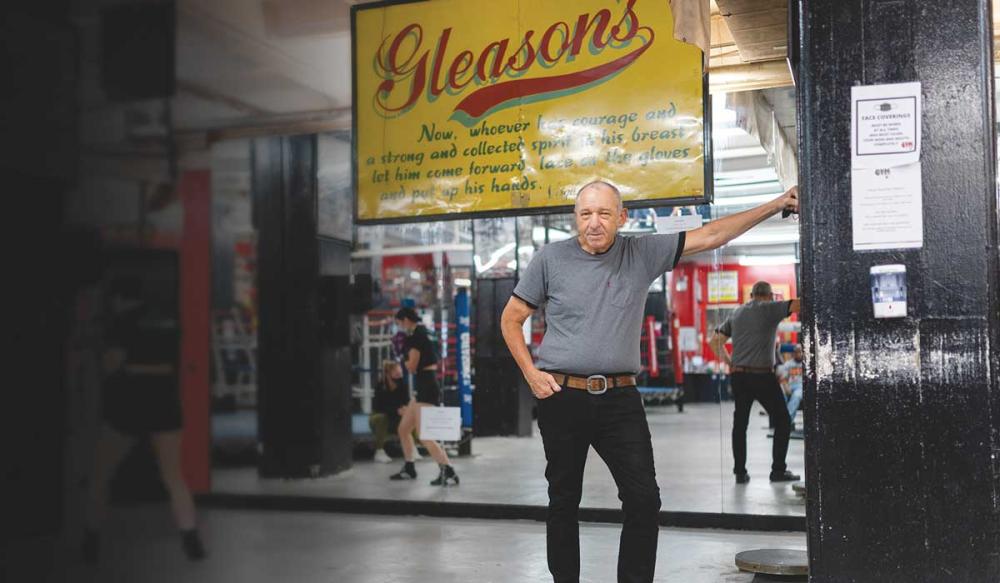
Gleason’s Gym
The Gym That Outlived New York’s Golden Age
Established 1937 · The Bronx · Manhattan · Brooklyn, New York
There was a time when New York stood at the centre of American boxing. Arenas, neighbourhood clubs, crowded training rooms, trainers, fighters, managers, and spectators formed a dense urban fight world. Many of its institutions disappeared.
Gleason’s Gym
Founded in the Bronx in 1937, Gleason’s survived boxing’s changing fortunes, the loss of New York’s old fight landmarks, multiple relocations, and the transformation of the neighborhoods around it. Across almost nine decades, generations of fighters continued to pass through its doors. Gleason’s describes itself as the oldest active boxing gym in the United States.
Its importance is not built around one trainer, one champion, or one period. It is built around continuity.
1937 — A Different Name for a New York Fight Crowd
The gym was founded by Peter Robert Gagliardi, a former flyweight who later competed as a bantamweight. He changed his name to Bobby Gleason because an Irish-sounding name was more likely to appeal to New York’s heavily Irish boxing audience at the time.
He opened the gym in the Hub district of the lower Bronx in 1937. Membership cost two dollars per month and rent was fifty dollars, but even that was difficult to meet. Gleason drove a taxi for ten to twelve hours at night to keep the business alive.
The institution later associated with world champions began without prestige or financial security: a former fighter worked through the night so the doors could open again the next day.
The Bronx
The original Gleason’s was an upstairs working gym: a central ring, heavy bags, speed bags, mirrors, changing facilities, and seats close enough for spectators to study fighters at work. On busy afternoons, every bag moved and the wait to enter the ring could stretch beyond an hour. Its reputation grew alongside fighters such as Mike Belloise, Phil Terranova, Jimmy Carter, Carlos Ortiz, Benny “Kid” Paret, and Jake LaMotta. These were not celebrity visits added to an already famous address. They belonged to the period in which Gleason’s became part of New York’s working boxing infrastructure.
The Last Remnant
Boxing prospered in New York through the 1940s and 1950s, but by the 1960s its old urban structure was weakening. Stillman’s Gym closed, and the old Madison Square Garden on Eighth Avenue disappeared. According to Gleason’s own history, those losses left the Bronx gym as a remaining link to New York boxing’s earlier golden age. In the Fight Heritage reading, this is the central meaning of Gleason’s: it is not merely old. It remained active while much of the ecosystem that created it was being dismantled.
Cassius Clay Before Muhammad Ali
Before Cassius Clay defeated Sonny Liston in February 1964, his principal training camp was Miami Beach’s 5th Street Gym under Angelo Dundee. Gleason’s official history also records that Clay used Gleason’s during his preparation for the fight.
1974 — Manhattan
After thirty-seven years in the Bronx, Bobby Gleason moved the gym to West 30th Street in Manhattan in 1974. The larger location contained two training rings, heavy bags, speed-bag stations, mirrored rooms, offices, a luncheonette, and a mezzanine overlooking the floor. Gleason’s official history describes it as New York’s first street-level boxing gym.
The address changed. The function did not.
Héctor Camacho, Julio César Chávez, Riddick Bowe, Larry Holmes, Michael Spinks, Mike Tyson, and Gerry Cooney were among the champions and contenders associated with the 30th Street period; Thomas Hearns and Wilfred Benítez also trained there at times.
Gleason’s was not defined by one trainer or one recognisable style. It was a crossroads where fighters, trainers, methods, nationalities, and eras overlapped.
Roberto Durán and the Street Outside
Roberto Durán used Gleason’s as a New York training base during periods of his career, working there with Ray Arcel and Freddie Brown. His sessions attracted such attention that, according to the gym’s history, the street occasionally had to be managed to accommodate the crowd. Durán’s relationship with Gleason’s captures one of the gym’s defining qualities: it could remain a serious working training room while also becoming a public site of boxing culture. It was not a museum of past fighters. The work was still taking place.
The Trainers Behind the Names
A list of champions can make a gym sound important. Trainers explain why it remained important. Whitey Bimstein, Freddie Brown, and Ray Arcel were among the renowned trainers associated with Gleason’s across its Bronx and Manhattan eras. In later decades, Hector Roca became one of its defining modern trainers, working with champions including Arturo Gatti, Iran Barkley, Héctor Camacho, Regilio Tuur, Heather Hardy, and Alicia Ashley, and helping guide Gatti to his first world title in 1995.
A gym survives because knowledge is transmitted. The ring, bags, and walls provide the location; trainers preserve the methods, corrections, habits, language, and discipline that pass from one generation to the next.
The Champions Who Called It Home
Gleason’s currently states that 137 world champions have called the gym home, alongside hundreds of amateur champions and Olympic medallists. The number should be understood carefully: some fighters were developed there, some made it their regular base, and others trained there temporarily or for particular contests. The value of the figure is its range. The gym’s history touches heavyweight champions such as Muhammad Ali, Larry Holmes, Michael Spinks, Riddick Bowe, and Mike Tyson, alongside champions across many other divisions including Jake LaMotta, Roberto Durán, Thomas Hearns, Wilfred Benítez, Héctor Camacho, Julio César Chávez, and Arturo Gatti. Few institutions connect so many eras without being defined by only one of them.
Boxing’s Image of Itself
Gleason’s physical character attracted people outside boxing long before combat sports became a familiar visual language in advertising and fashion. The Manhattan gym became a filming location for productions including Raging Bull. Robert De Niro trained there while preparing to portray Jake LaMotta, and Wesley Snipes trained there for Streets of Gold. Later, Hector Roca prepared Hilary Swank for Million Dollar Baby, while Michelle Rodriguez received boxing preparation for Girlfight. The worn equipment, crowded walls, old rings, trainers’ voices, and accumulated marks of use helped shape what audiences imagined a serious boxing gym should look like. In the Fight Heritage reading, Gleason’s did not only help train fighters. It helped shape boxing’s visual memory.
Women Enter the Gym
Women began training at Gleason’s in 1983. The change was not immediate or seamless: the Manhattan location initially had only one changing and shower area, so the gym closed early on certain evenings to create dedicated training time for women. By the time Gleason’s later moved to Brooklyn, the women’s programme had grown enough to receive separate facilities.
The shift matters because heritage is often presented as the protection of an unchanged past. Gleason’s survived by changing who could participate in its future. Women became competitors, trainers, members, and champions within its community.
Bronx. Manhattan. Brooklyn.
Gleason’s began in the Bronx in 1937, moved to Manhattan in 1974, relocated to Brooklyn’s DUMBO district in the 1980s, and moved to its current Water Street home in 2016. Each move could have ended the institution. Instead, the name, trainers, community, records, photographs, and working culture moved with it. Its continuity does not depend on one untouched room. Bronx born. Manhattan proven. Brooklyn preserved.
Bruce Silverglade
Bruce Silverglade purchased a stake in Gleason’s in the 1980s and became its sole owner in 1991. He became the principal custodian of its modern history, preserving its archives and public profile while expanding its function beyond professional boxing.
Under Silverglade, Gleason’s remained a serious training environment while opening itself to a much wider membership. Professionals, champions, young fighters, businesspeople, and complete beginners could occupy the same environment. That mixture became part of how the gym’s identity survived.
The Ring as a Shared Space
Today, Gleason’s programmes extend beyond conventional amateur and professional boxing, reaching young people, veterans, people living with Parkinson’s disease, and other communities through charitable initiatives built around health and access.
The championship tradition remains visible, but the ring is not meaningful only because famous fighters once entered it. It remains meaningful because new people continue to enter it.
Gleason’s Gym Way
In 2024, a corner in Brooklyn’s DUMBO was formally co-named Gleason’s Gym Way. Silverglade described the recognition as belonging not to one owner or fighter, but to the accumulated community of champions, amateurs, trainers, filmmakers, and members who contributed to the gym’s history. The street sign did not make Gleason’s a historical institution. It acknowledged what decades of survival had already made it.
Why Fight Heritage Selected Gleason’s Gym
Fight Heritage selected Gleason’s because its story demonstrates that heritage is not simply age.
Heritage is continuity with meaning.
Gleason’s survived the decline of New York’s older boxing world, relocation, changes in ownership, neighbourhood, audience, and the economics of the sport. It trained local fighters, hosted visiting champions, preserved coaching knowledge, entered cinema, opened its doors to women, and continued creating access beyond professional boxing.
The gym did not remain important by refusing to change. It remained important by protecting what mattered while allowing the institution to evolve.
In the Fight Heritage reading, Gleason’s represents something increasingly rare: a living boxing institution whose history is not sealed behind glass. The bells still ring. The bags still move. Trainers still correct a stance, reposition a foot, and ask for another round.
Champions have passed through Gleason’s. The gym remained. That is why it belongs in the Fight Heritage Archive.
Archive details:
Story number: 002
Subject: Gleason’s Gym
Category: Boxing gym
Sport: Boxing
Themes: continuity · New York · training · community · heritage
Founded: 1937
Origin: the Bronx, New York, USA
Locations: the Bronx · Manhattan · Brooklyn
Current location: 130 Water Street, Brooklyn, New York
Related product: Men’s Gleason’s Gym Crew Neck T-Shirt
Collection: Gleason’s Gym
Selected and edited by: Fight Heritage
Last verified: 5 August 2026
Pieces from this story
The story before the piece
Sources
- Founding and Bobby Gleason
Library of Congress and Gleason’s official history.
- The Bronx and Manhattan years
Gleason’s official history.
- Clay / Liston preparation
Gleason’s official history, CBS and the Smithsonian, alongside contemporary coverage of the 5th Street Gym.
- Champions and trainers
Gleason’s official history, and independent profiles and biographies.
- Film connections
Independent press and film sources.
- Silverglade and membership
Independent profiles and interviews.
- Gleason’s Gym Way
2024 coverage and official announcements.