
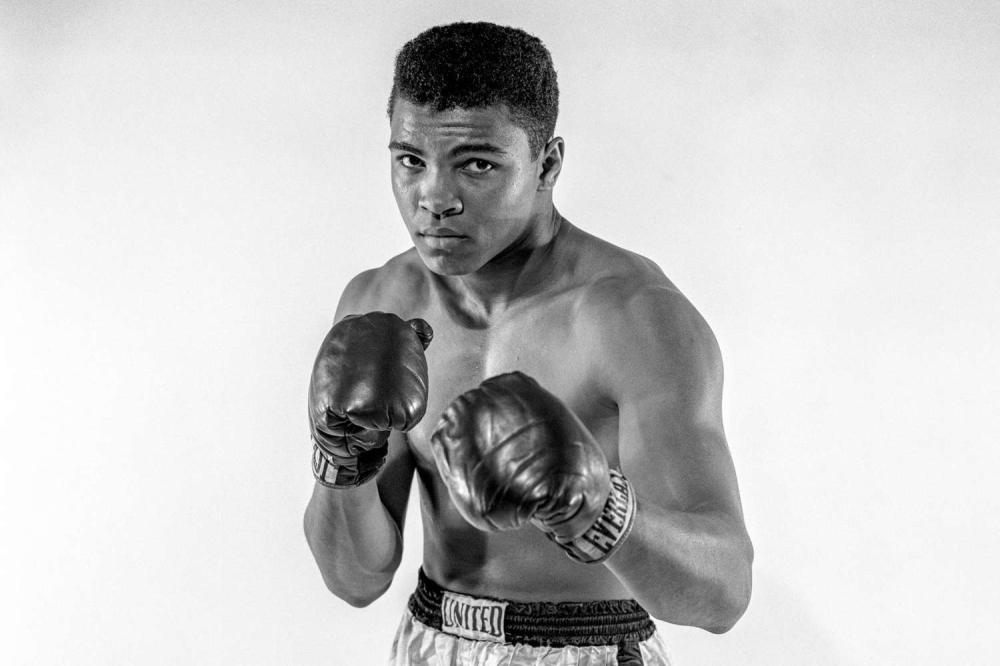
Story 001 - MUHAMMAD ALI
The Greatest
January 17, 1942 — June 3, 2016
Louisville, Kentucky, United States
Muhammad Ali was not the greatest because he won more than anyone else. He was the greatest because he changed what an athlete was allowed to be.
A Stolen Bicycle
In October 1954, in Louisville, Kentucky, a twelve-year-old named Cassius Marcellus Clay Jr. left his red Schwinn bicycle outside the Columbia Auditorium and went inside to an event. When he came out, the bicycle was gone. He was told there was a police officer in the basement. He went down and found a boxing gym, and in it, Joe Martin, an off-duty Louisville officer who coached boxing there. The boy said he intended to beat up whoever had taken the bike. Martin told him he had better learn to box first. The story started in that basement.
Rome, 1960
Six years later, at age eighteen, Clay won the light heavyweight gold medal at the Rome Olympics.
He returned to the United States an Olympic champion and found that the medal had changed nothing about how Black Americans were treated in his own country.
Miami, 1964
On February 25, 1964, Clay faced Sonny Liston, the reigning world heavyweight champion. Clay was twenty-two and undefeated at 19–0, and still entered as a heavy betting underdog. At the end of the sixth round, Liston refused to continue, citing a shoulder injury, and did not answer the bell for the seventh. Clay was heavyweight champion of the world.
The Name
The following day, Clay confirmed his membership in the Nation of Islam and announced he would be known as Cassius X, rejecting his surname as a slave name. On March 6, 1964, Nation of Islam leader Elijah Muhammad announced that the new champion had been given another name: Muhammad Ali. Many American newspapers refused to use it for years, and did not drop the old name from their headlines until after his return to the ring in 1970.
Lewiston, 1965
On May 25, 1965, the rematch with Liston in Lewiston, Maine, ended in the first round. Liston went down. Ali stood over him, demanding he rise. The punch was so fast that many present said they never saw it. It became known as the phantom punch, and the argument over it has never ended. The photograph taken in that moment became one of the most recognizable images in the history of sport.
In the Fight Heritage reading: it is no longer a record of a victory, but the image of a man who never knew a quiet one.
1967 — The Refusal
On April 28, 1967, at the induction center in Houston, Ali’s name was called three times, and three times he refused to step forward, citing his religious objection to military service. That same day the New York State Athletic Commission suspended his license and stripped his title. Other commissions followed. On June 20, 1967, a Houston jury convicted him of refusing induction. He was sentenced to five years in prison and fined $10,000. He never served the sentence — he remained free throughout the appeals. Still, he lost more than three and a half years of his career, from twenty-five to twenty-eight, the peak of any fighter’s life. He spent them touring American universities, defending his position before packed halls.
1970 — The Return
On October 26, 1970, having obtained a license to box in Georgia, Ali stopped Jerry Quarry in the third round — his first fight in more than three years.
1971 — The Supreme Court
On June 28, 1971, the United States Supreme Court overturned his conviction unanimously, finding that the rejection of his conscientious-objector claim had not been properly grounded.
The ruling came eight months after his return to the ring, not before it.
The Trilogy and the Jungle
March 8, 1971 — The Fight of the Century. Joe Frazier, then the reigning champion, at Madison Square Garden. Ali lost by unanimous decision over fifteen rounds — the first defeat of his professional career. October 30, 1974 — The Rumble in the Jungle. In Kinshasa, Zaire, against George Foreman, the undefeated champion at 40–0, with Ali a 4–1 underdog. He leaned on the ropes round after round, absorbing punishment and draining his opponent in a plan later known as the rope-a-dope, then dropped Foreman just before the end of the eighth to reclaim the title at thirty-two. October 1, 1975 — The Thrilla in Manila. The third and cruelest of his meetings with Frazier. Frazier’s trainer Eddie Futch stopped the fight before the fifteenth round, with Frazier’s eyes swollen nearly shut. Ali later described that night as the closest he had come to death.
Three Times
On February 15, 1978, he lost the title to Leon Spinks. In September of the same year, he took it back, becoming the first fighter to win the world heavyweight championship three times.
Faith After Elijah Muhammad’s death in 1975, the Nation of Islam moved under his son Warith Deen Muhammad toward mainstream Sunni Islam, and Ali moved with it. Faith became the framework through which he explained the most important decisions of his life — the refusal, the retirement, and the long years of illness.
The Final Chapters
On December 11, 1981, he lost to Trevor Berbick in his last professional fight and retired at thirty-nine with a record of 56 wins and 5 losses, 37 by knockout. In 1984, three years after retiring, he was diagnosed with Parkinson’s disease.
Then came the moment the world kept. On July 19, 1996, at the opening ceremony of the Atlanta Olympics, he took the flame from swimmer Janet Evans. His hand shook in front of a global television audience.
He made no attempt to hide it. He lit the torch that carried the fire to the cauldron, in one of the most enduring moments in the history of the Games. He died on June 3, 2016, at age seventy-four.
Why This Became Artifact 001
We chose Muhammad Ali as Artifact 001 because his story is not the story of a champion. It is the story of a shift.
Before him, an athlete was expected to perform and stay quiet. After him, an athlete had a voice — and that voice had a price.
In the Fight Heritage reading, every fighter who has spoken since, and every athlete who has taken a stand, stands on ground Muhammad Ali cleared.
Pieces from this story
Roots of Fight — Muhammad Ali | White Tee · Roots of Fight — Muhammad Ali The Greatest | Yellow Tee
#Fight Heritage
The story before the piece.
Archive details
Story number | 001
Subject | Muhammad Ali
Category | Fighter
Discipline | Boxing
Themes | Heritage
Era | 1940s – 2010s
Origin | Louisville, Kentucky, USA
Collection | Roots of Fight
Curated and prepared by | Fight Heritage
Last verified | August 2026