
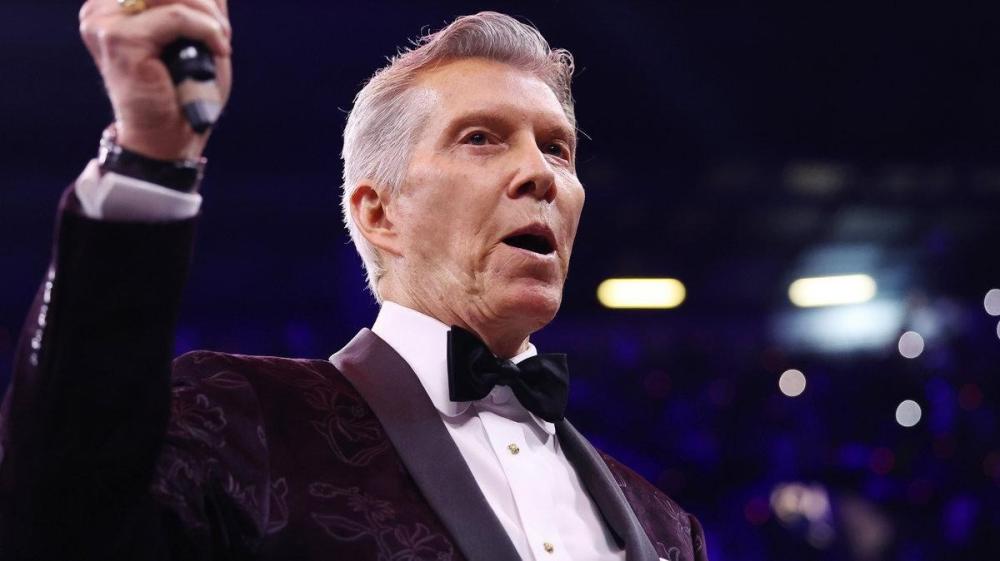
Story 011 — Michael Buffer: The Five Words That Became a Boxing Legend
From selling cars to becoming the voice of boxing’s biggest nights, Michael Buffer transformed a late career start into one of the most recognizable identities in sports history.
Imagine sitting among thousands of spectators inside a packed arena. The lights are focused on the ring. Two fighters stand ready, months of anticipation building toward a single moment.
Then a man in a perfectly tailored tuxedo raises his microphone.
His voice rises above the noise of the crowd.
“LET’S GET READY TO RUMBLE!”
Five words.
That is all it takes to ignite an arena and signal that the moment everyone has been waiting for has finally arrived.
For more than four decades, Michael Buffer’s voice has been woven into the soundtrack of professional boxing. It has accompanied legendary fighters, historic rivalries, and some of the sport’s most unforgettable nights.
Yet the man behind that voice did not grow up dreaming of becoming a ring announcer.
He entered the profession at an age when many people are already firmly established in their careers.
His first performance was far from impressive.
And the phrase that eventually made him famous began as an attempt to solve a simple problem: how to keep an audience excited before a fight.
This is the story of Michael Buffer.
Before the Ring: Cars, Modeling, and an Unexpected Career
Michael Buffer was born on November 2, 1944, in Philadelphia, Pennsylvania.
His childhood was unconventional. His biological parents separated when he was an infant, and he was raised by foster parents in the Philadelphia area.
As a young man, Buffer served in the United States Army before pursuing several careers that had little to do with professional sports.
He worked as a car salesman and later became a fashion model, appearing in commercial advertising and developing the polished appearance that would eventually become one of his trademarks.
With his carefully styled hair, elegant clothing, and confident presence, Buffer looked more like a television personality than someone associated with the rough world of professional boxing.
But he was a boxing fan.
He followed the sport closely, enjoying the fighters, the atmosphere, and the spectacle surrounding major events.
What he did not anticipate was that a casual observation during a televised fight would change the direction of his life.
The Remark from His Son That Changed Everything
In the early 1980s, Buffer was watching a boxing match on television with his teenage son, Michael.
The fight ended in a split decision, one of boxing’s most suspenseful outcomes.
The audience waited to hear how the judges had scored the contest.
But according to Buffer’s later recollection, the ring announcer revealed the result in a way that destroyed the suspense, announcing the two decisive scores before the final scorecard.
Buffer’s son was unimpressed.
He suggested that his father could do a better job.
It was a simple comment, but Buffer began considering the possibility seriously.
Atlantic City was emerging as an important destination for professional boxing, with hotels and casinos staging regular fight cards.
Buffer recognized an opportunity.
Drawing on his modeling experience, he sent photographs and introductory letters to several venues, presenting himself as someone capable of bringing a more polished, theatrical presence to the ring.
He later admitted that he had exaggerated his announcing experience in his attempts to secure a position.
Eventually, someone gave him a chance.
It would become one of the most important opportunities of his life.
But his first night did not go particularly well.
October 1982: A Difficult Beginning
In October 1982, Michael Buffer stepped into a boxing ring as an announcer for the first time at the Playboy Hotel and Casino in Atlantic City.
He was 37 years old, just weeks away from turning 38.
Despite his confident appearance, the performance was disappointing.
Years later, Buffer openly acknowledged just how poorly he had handled the occasion.
In a recollection published by the New Jersey Boxing Hall of Fame, he described his debut as terrible and admitted that remembering it still embarrassed him.
Promoter Bob Arum also recalled Buffer’s difficult early performances, including occasions when he confused names and struggled with his announcements.
For someone attempting to enter an unfamiliar profession relatively late in life, it could easily have been the end of the experiment.
Instead, Buffer continued.
In March 1983, promoter Frank Gelb gave him another opportunity, along with advice that helped him improve his performance.
He began working on his delivery, learning how to control the pacing of his announcements and how to command an audience.
His appearances on Top Rank boxing cards televised by ESPN gradually introduced him to a much larger audience.
Yet Buffer understood that simply reading the fighters’ names, records, and titles would never make him truly distinctive.
He needed something more.
Something audiences would immediately associate with him.
The Birth of “Let’s Get Ready to Rumble!”
Buffer noticed something during major boxing events.
The fighters would make their entrances to loud music and excited crowds. The atmosphere would reach a fever pitch.
Then the ring announcer would begin reading the names of officials, judges, physicians, and other individuals involved in the event.
As the announcements continued, the audience’s energy often faded.
To Buffer, this was a problem.
The excitement should have been building toward the opening bell, not disappearing just before the fighters were introduced.
He wanted a phrase that would refocus the audience and restore the atmosphere.
He drew inspiration from the ceremonial calls used in American motorsports, particularly the familiar command:
“Gentlemen, start your engines.”
He experimented with several phrases, but none seemed to deliver the impact he wanted.
Then he turned to one of boxing’s greatest showmen.
Muhammad Ali.
Ali had transformed the language of boxing through his poetry, humor, predictions, and verbal performances.
He understood that a fight began long before the opening bell.
Among the expressions associated with Ali and his longtime assistant Drew “Bundini” Brown was:
“Rumble, young man, rumble.”
Buffer also recalled similar expressions used by boxing commentators of the era.
He adapted the idea into a short, rhythmic command:
“LET’S GET READY TO RUMBLE!”
By approximately 1983–1984, Buffer was developing the delivery that would make the phrase famous.
Its impact was not simply in the words themselves.
It was in the performance.
The deliberate pacing.
The rising intensity.
The extended pronunciation.
And the explosive emphasis on the final word.
What began as a practical way to energize an audience became a ritual.
For boxing fans, the phrase meant one thing:
The waiting was over.
The fight was about to begin.
When Five Words Became a Business
As Buffer’s reputation grew, so did the popularity of his signature phrase.
It began appearing beyond the boxing ring, becoming recognizable in advertisements, entertainment, and other sporting events.
Buffer realized that the phrase had commercial value independent of the fights he announced.
During the early 1990s, he took steps to protect it as a trademark, establishing the foundations of a licensing business built around his voice and signature expression.
The phrase eventually appeared in advertisements, video games, merchandise, and promotional campaigns.
One particularly recognizable example was the Ready 2 Rumble Boxing video game franchise, which introduced Buffer’s voice and catchphrase to a generation of gaming fans.
The commercial success attracted considerable media attention.
Some reports claimed that the phrase had generated as much as $400 million.
However, Buffer later disputed the widely repeated figure when it was presented as his personal earnings, explaining that the amount he had actually made was substantially lower.
The precise financial value is less important than what the achievement represents.
Buffer had transformed a short phrase into a commercially valuable brand.
He did not simply become famous for performing a job.
He made the performance itself a recognizable product.
His voice became part of the business of boxing.
From a marketing perspective, it was an extraordinary example of how repetition, consistency, distinctiveness, and emotional association can create a powerful brand identity.
The Voice of Boxing’s Biggest Nights
As the years passed, Michael Buffer became increasingly associated with boxing’s most prestigious events.
His career spanned generations of fighters, promoters, venues, and television networks.
He announced fights involving legends such as Mike Tyson, Roberto Durán, Lennox Lewis, Floyd Mayweather Jr., and Manny Pacquiao.
His long association with major televised boxing events, particularly those broadcast by HBO, further established him as one of the sport’s defining personalities.
But Buffer was more than someone who introduced fighters.
His presence signaled the importance of the occasion.
When he stepped into the center of the ring, audiences knew that the moment had arrived.
One of the events he remembered vividly was the 1988 heavyweight championship fight between Mike Tyson and Michael Spinks.
The event carried enormous anticipation.
Yet the fight itself lasted only 91 seconds, ending with a devastating first-round knockout by Tyson.
Buffer later recalled how the elaborate introductions and celebrity acknowledgments surrounding the event lasted considerably longer than the contest.
Another memorable evening came in 1989, when Roberto Durán defeated Iran Barkley in Atlantic City.
And among the greatest moments he witnessed was George Foreman’s remarkable victory over Michael Moorer in 1994, when Foreman reclaimed the heavyweight championship at the age of 45.
Throughout these changing eras, Buffer remained a familiar figure.
The champions changed.
The rivalries changed.
The television landscape changed.
But his voice continued to provide a recognizable link between generations of boxing history.
Two Brothers, Two Legendary Voices
Boxing did more than transform Michael Buffer’s professional life.
It also helped reconnect him with a family he had barely known.
Because Buffer had been raised by foster parents, he had grown up largely separated from his biological relatives.
His growing visibility on television eventually led members of his family to recognize him.
In 1989, Buffer connected with his biological father and relatives, including his half-brother, Bruce Buffer.
Bruce would eventually establish his own career as one of the world’s best-known combat sports announcers.
While Michael became associated with boxing and the phrase “Let’s Get Ready to Rumble,” Bruce became the iconic voice of the Ultimate Fighting Championship (UFC).
His signature introduction, “It’s Time!”, would become an equally recognizable part of mixed martial arts culture.
The brothers also developed a business relationship, working together in managing Michael’s commercial opportunities and licensing interests.
Their story is unusual.
Two brothers who spent much of their early lives apart went on to become two of the most recognizable voices in combat sports.
One synonymous with boxing.
The other with MMA.
Both demonstrating how the person holding the microphone can become part of the spectacle itself.
2008: The Voice That Almost Disappeared
In 2008, Buffer faced one of the most serious challenges of his life.
He was diagnosed with throat cancer and underwent surgery to remove the tumor.
For someone whose livelihood and identity depended so heavily on his voice, the diagnosis was especially frightening.
Suddenly, the ability that had made him famous was at risk.
In March 2008, Buffer worked the Manny Pacquiao–Juan Manuel Márquez fight knowing that he might not be able to return to the microphone after surgery.
The occasion carried a private significance that most of the audience did not fully understand.
When he delivered his famous introduction, he was confronting the possibility that it could be among his last.
Fortunately, the operation was successful.
Buffer recovered and, in April 2008, returned to the ring for the Joe Calzaghe–Bernard Hopkins fight.
The comeback represented far more than another professional assignment.
The man whose career had been built on five words had nearly lost the ability to deliver them.
But he returned.
And once again, the audience heard the voice that had become synonymous with boxing’s biggest moments.
Why Michael Buffer Became a Legend
Professional boxing has featured countless commentators, announcers, presenters, and television personalities.
Yet very few have become as closely connected to the sport’s identity as Michael Buffer.
His success cannot be explained by his voice alone.
It is the combination of several qualities.
His carefully cultivated appearance gave him an unmistakable visual identity.
His formal delivery conveyed prestige and importance.
His pacing transformed routine introductions into dramatic performances.
And his signature phrase created a consistent emotional signal that audiences learned to anticipate.
But perhaps his greatest achievement was understanding the power of the moment.
Boxing is more than a competition decided by punches, points, and knockouts.
It is also an event built on anticipation.
The walkouts.
The music.
The lighting.
The crowd.
The fighters standing across from one another.
Buffer understood that his job was to connect these elements and bring them to a climax.
He did not invent the excitement surrounding major fights.
He gave that excitement a distinctive voice.
Over time, the phrase became part of popular culture, appearing in settings far beyond professional boxing.
It was no longer simply an introduction.
It was an unmistakable signal that something important was about to happen.
Five Words, a Lasting Legacy
On November 2, 2026, Michael Buffer turned 82.
More than four decades have passed since his difficult debut in Atlantic City.
At the time, he was a man entering an unfamiliar profession with little practical experience and no guarantee of success.
He could not have known that his voice would eventually become one of the most recognizable sounds in world sport.
Nor could he have imagined that a phrase developed to maintain the excitement of a boxing crowd would grow into an internationally recognized trademark.
His journey reminds us that sporting history is not created exclusively by those who compete.
Some people shape the sport through their victories.
Others shape the memories surrounding those victories.
Michael Buffer belongs to the latter group.
He never needed to win a world championship.
He never needed to throw a punch.
He found his place in boxing history with a microphone, an unmistakable voice, and five unforgettable words.
FIGHT HERITAGE
The Story Before the Piece.
Sources and Further Reading
1. New Jersey Boxing Hall of Fame — Michael Buffer — Buffer’s account of his first appearance in October 1982 and his second opportunity in March 1983.
2. PhilBoxing — Michael Buffer Interview (2009) — His son’s suggestion, the beginnings of his career, and the development of his signature phrase.
3. Philadelphia Magazine — Exit Interview: Michael Buffer — His early career, famous catchphrase, and personal experiences.
4. CBS News — Let’s Get Ready to Rummbblle — Buffer’s explanation of the influence of Muhammad Ali.
5. ABC News — The Man Behind the Catchphrase — The commercial development of his phrase and aspects of his personal life.
6. Los Angeles Times — His Voice Rumbles Again — Contemporary coverage of his 2008 cancer surgery and return to announcing.
7. Fox Business — Michael Buffer Interview (2019) — His discussion of the commercial value of his trademark and correction of widely circulated earnings estimates.
8. BoxingScene — Bob Arum Recalls Buffer’s Early Career — Arum’s account of Buffer’s difficult early performances.