
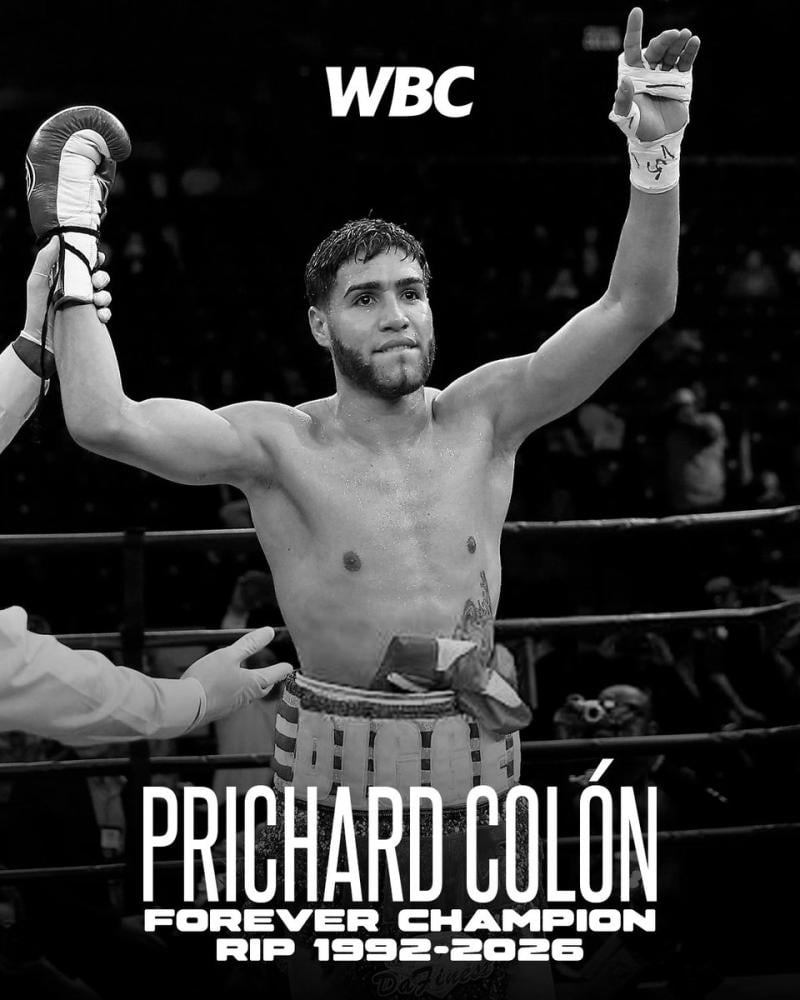
Prichard Colón: The Fight That Didn’t End at the Bell
In boxing, some fights end with the final bell.
Others continue long after the fighters leave the ring.
Prichard Colón’s story belongs to the latter.
Colón was one of Puerto Rico’s rising professional boxing prospects. Before October 17, 2015, his record was perfect: 16 fights, 16 victories, 13 by knockout. His career was moving quickly; 14 of those 16 fights had taken place within the previous two years, as the level of opposition continued to rise.
The Night That Changed Everything
On October 17, 2015, Colón entered the ring at EagleBank Arena in Fairfax, Virginia, to face Terrel Williams.
Both fighters entered undefeated.
What began as a meeting between two promising fighters would become the dividing line between the life Colón knew before that night and everything that followed.
The bout included fouls and point deductions. Colón lost two points for a low blow ruled intentional, while Williams was deducted a point in the seventh round for a punch to the back of Colón’s head. During the fight, Colón had complained about being struck behind the head.
In the ninth round, Colón went down twice.
After the round ended, his corner began removing his gloves, believing the fight was over. There was still a tenth round to come. Colón ultimately lost by disqualification after failing to answer the bell.
It became the first loss of his professional career.
Within minutes, however, the result of the fight mattered far less than what was happening outside the ring.
From the Ring to the Hospital
After the fight, Colón’s condition deteriorated. He experienced dizziness and vomiting and was transported to the hospital, where doctors discovered a serious brain bleed and a subdural hematoma. Emergency surgery was required to relieve the swelling and evacuate the blood.
Colón subsequently entered a prolonged coma. Later reports put its duration at 221 days.
When he emerged from that period, he did not return to the life he had known before that night. The injury left him with profound neurological damage and a continuing need for care and rehabilitation.
His family’s life changed with his.
Prichard Colón was no longer chasing another victory inside the ring.
The fight had become something entirely different.
Nearly Eleven Years of Fighting
For nearly eleven years, Colón lived with the consequences of the injury he suffered that night.
Wins and knockouts were no longer the numbers that mattered. Treatment, rehabilitation and small signs of progress carried an entirely different meaning.
In 2021, the World Boxing Council (WBC) honored Colón as an honorary champion — recognition of the place his story had come to occupy within the boxing community.
On August 13, 2026, his father and former trainer, Richard Colón, announced that Prichard had died at the age of 33, nearly eleven years after the fight that changed his life. Tributes followed from across the boxing community.
PRICHARD COLÓN
1992 — 2026
What Should Boxing Remember?
It is easy to reduce Colón’s story to a single moment or a single punch.
What happened that night was more complicated than that — and that is precisely why the story matters.
Boxing is a sport built around inflicting damage within rules and boundaries designed to protect the fighters. Punches to the back of the head are prohibited for a reason. The referee, ringside physician, trainer, opponent and fighter are all parts of a system intended to make competition possible without abandoning responsibility for the person inside the ring.
The aftermath also reached the courts. In 2017, Colón’s family filed a lawsuit alleging negligence against the ringside physician, his medical practice and two promotional companies connected to the event. Court records describe allegations concerning symptoms Colón reported during the bout and the medical care surrounding what happened.
But there is another part of Colón’s story that extends beyond rules, medicine and litigation.
Prichard Colón entered the ring as a fighter.
When his boxing career ended, he was forced into a different kind of fight.
For years, he lived with the consequences of an injury that changed everything, while his family continued to stand beside him.
Perhaps the simplest message is also the most important:
Boxing is a responsibility.
Fight with integrity.
Protect yourself.
Respect your opponent’s safety.
And when life forces you into a fight you never chose, don’t give up.
Prichard Colón’s mark on boxing will remain.
Selected and edited by: Fight Heritage
Sources
Premier Boxing Champions — Colón vs. Williams, October 17, 2015
Official event record: the fight result and the disqualification details.
The Washington Post — October 17 & 19, 2015
Contemporary coverage of the fight, Colón’s complaints about blows to the back of the head, his deterioration, hospital transfer and surgery.
U.S. District Court for the District of Columbia — Colón et al. v. Ashby et al.
The court record of the lawsuit, with details of the medical and legal claims.
Fightnews — August 13, 2026
Coverage of Prichard Colón’s death, announced by his father.
Yahoo Sports — August 13, 2026
Coverage of his death at 33, nearly eleven years after the injury.